

Empower your brand with the standard for digital currency
-
Increase your efficiency of customer acquisition and retention
-
Finance your growth and digital transformation
-
Build a new source of data based on a fair agreement with your consumers
A currency for a successful ecosystemstarts with a strategic foundation.
Be the First Brand at Checkout
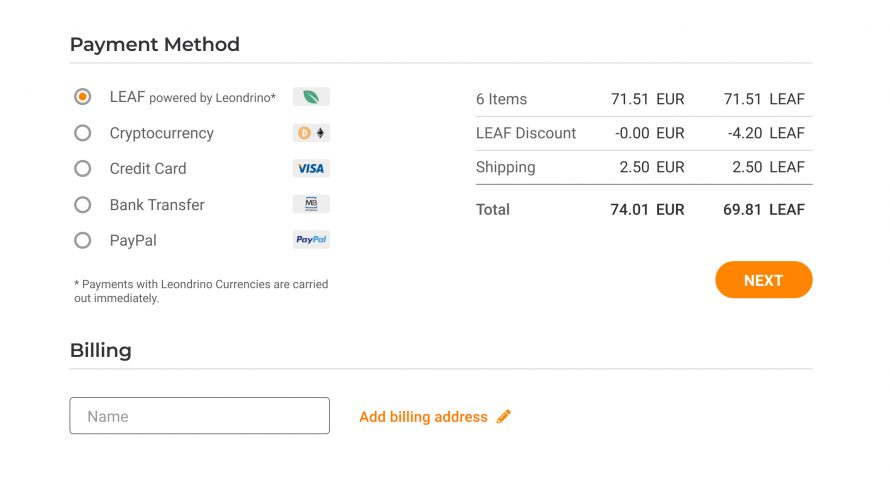
Supporting brands with the best possible concept of digital currencies through the Leondrino Standard
Leondrino Payments
Present Your Brand Logo
Undisturbed User Experience at Checkout
Direct Access to Users via Leondrino ID
Transaction Data based on User Consent
Instant Payments
No Chargebacks
Minimal Payment Fees
No Exchange Fees in Leondrino Currencies
Current Crypto
Payments
No Branding
Complicated User Experience at Checkout
Anonymous Users
Anonymous Transaction Data
Quick Payments
No Chargebacks
Fluctuating Payment Fees
Substantial Exchange Fees
Traditional Payments
No Branding
Disturbed User Experience at Checkout
Indirect or Costly Access to User Data
Indirect or Costly Access to Transaction Data
Variable Payment Speeds
Chargebacks
Variable Payment Fees
Substantial Exchange Fees
The Leondrino Network
Together with our partners, we offer our service for brands, enterprises, and established startups.

Regulation and Tax
Introduction of advisors who offer guidance on the legal and tax-related issues associated with Leondrino Token Classes.

Investor Relations
Establishment of reporting structures for digital currencies in addition to standard Investor Relations.

Business
Business plan analysis and adaption of your chosen scenario to the Leondrino Standard.

Marketing & PR
Marketing and PR support throughout the entire Leondrino Lifecycle.

Integration
IT-Integration with CRM, eCommerce, and ERP according to your brand's positioning.

For Analysts & Investors
Provide assessment methods based on token phase and industry, as well as exchange of experience on emerging peer groups.
Features for Brands
Benefit from integration with supporting services of the Leondrino Ecosystem.
Blueprint of Token Rollout
for Leondrino Currencies
Dashboard
for Token Launch and Payment Analytics
App Store
(planned)
for Standard Interfaces and Domain Specific Apps
AI
for Transaction Data Analysis
FAQ for Brands
An Enterprise Currency does not start as money.
It starts as a contractual claim on the future goods and services of the issuing company. If an airline issues purchasing power that can be redeemed for future flights, or an energy company issues a currency redeemable for energy and related services, the issuer is creating a claim against its own productive capacity.
This is closer to productive credit than to the creation of a new national currency.
Companies have issued such claims for centuries — through commercial credit, vouchers, prepaid services, gift cards, or loyalty programs. What changes with an Enterprise Currency is that these claims can become standardized, digital, transferable, and increasingly usable within a broader economic ecosystem.
At Leondrino, we therefore do not start by privatizing money.
We start by digitizing productive credit.
Only when an Enterprise Currency becomes increasingly transferable and widely accepted does it begin to acquire monetary characteristics. As it evolves, requirements regarding reserves, convertibility, governance, and regulation increase accordingly.
They could — if designed that way.
Traditional loyalty systems are usually closed by design. Points may expire, transferability is restricted, redemption is controlled by the issuer, and customers often have little influence over the economic value of their accumulated claims.
Enterprise Currencies can follow a different path.
The Leondrino model is based on the idea that an issuer’s obligations should become more transparent and that a currency can become progressively more open as it matures.
Three principles are particularly important:
- Issuer obligation.
The currency represents an obligation of the issuer and its ecosystem to provide defined goods, services, or economic value. - Increasing transferability.
As the currency matures, its usability can extend beyond the original bilateral relationship between issuer and customer. - Increasing financial safeguards.
As a currency becomes more widely usable and begins to resemble general-purpose money, reserve requirements, convertibility, governance, and regulatory oversight become increasingly important.
The objective is therefore not to create more powerful closed loyalty systems.
It is to transform closed corporate claims into increasingly open, transparent, and transferable economic claims.
The difference becomes particularly interesting when Enterprise Currencies are used to finance future economic activity.
Consider a company that needs working capital.
In the traditional model, it may borrow €10 million from a bank. The company receives money today and assumes a financial obligation to repay €10 million plus interest.
An Enterprise Currency creates another possibility.
A company can issue purchasing power against goods or services it expects to provide in the future. Customers, suppliers, partners, or other participants in its ecosystem can acquire and use that purchasing power.
The resulting liability is fundamentally different.
It can be settled through production rather than through repayment of interest-bearing financial debt.
This does not mean that Enterprise Currencies replace banks. Banks perform many functions that corporate currencies cannot and should not replace.
But Enterprise Currencies may create an additional channel through which economically productive companies can finance part of their future activity directly through their customers and business ecosystems.
In that sense, they can reduce dependence on financial intermediation for certain forms of working capital.
Its economic anchor.
Many crypto assets derive their value primarily from scarcity, expectations of future demand, or the expectation that someone else will buy the asset at a higher price.
An Enterprise Currency starts from a different economic proposition.
Its fundamental anchor is the issuer’s obligation to provide goods, services, or other defined economic value.
An airline currency is ultimately connected to transportation services. An energy currency can be connected to the production, storage, distribution, or consumption of energy. A retail currency is connected to goods and services available within the issuer’s commercial ecosystem.
This does not mean that market prices can never fluctuate or that speculation can be eliminated.
But speculation should not become the economic purpose of the currency.
If an Enterprise Currency becomes detached from the productive economy underlying it and its principal attraction becomes speculative appreciation, it has failed an important part of its original purpose.
The Leondrino lifecycle is designed to address precisely this challenge.
Enterprise Currencies can evolve through different stages, from limited utility and restricted transferability toward broader acceptance and, ultimately, reserve-backed monetary characteristics.
The monetary character of the currency grows with the scope of the issuer’s obligation and with its growing fractional reserves.
The underlying economic idea is not new.
And that is important.
Enterprise Currencies do not depend on inventing an entirely new theory of money. Companies have always created claims against their future production.
What has been missing is an infrastructure that allows such claims to evolve systematically.
Leondrino provides a standardized lifecycle through which a corporate claim can develop from a limited-purpose instrument into an increasingly transferable and broadly usable currency.
In simplified form:
Corporate claim
- Transferable utility value
- Transferable purchasing power
- Broader ecosystem acceptance
- Reserve-backed currency
The innovation is therefore not the existence of corporate credit.
It is the creation of a technological, economic, and regulatory framework through which productive corporate credit can gradually acquire monetary properties while the safeguards surrounding the currency increase at the same time.
This leads to a broader question.
Modern financial systems are highly effective at creating credit against existing financial and real-estate assets. But could we also create better mechanisms through which productive enterprises issue credit directly against their future output?
We believe Enterprise Currencies can become one such mechanism.
They offer the possibility of connecting money more directly to production, customers more directly to the companies they value, and corporate financing more directly to future economic activity.
That is the economic idea behind Leondrino Enterprise Currencies.
In general, a branded corporate currency – like a fiat currency issued by a sovereign central bank – is subject to life cycle management. This life cycleis determined by the performance of the brand company associated with the currency, strict adherence to the monetary policy of the responsible issuer, and acceptance by consumers and investors.
In contrast to the cryptocurrency Bitcoin, whose maximum quantity is absolutely limited, Leondrino is pursuing a dynamic monetary policy defined by the number of the brand’s respective consumer base, business dynamics, and transactions for the highest token class A. The goal is to minimize volatility. As part of the approach, part of the fiat currency raised at ILO will be kept as a reserve. The expansion of the money supply and the buyback in the event of a price decline are controlled by software within certain limits. In the event of larger fluctuations, intervention by trained specialists on behalf of the Monetary Board of a corporate currency is envisaged.
If a brand ceases to exist, the associated currency will be taken from the market, once all collateral of this branded token has been liquidated and the proceeds from this collateral and the remaining excess cash reserves in fiat currency for the control of the money supply have been returned to the then remaining holders of the brand currency.
A brand currency is also delisted from Leondrino via a comparable process if both the reference value to a fiat currency (e.g. US dollar or euro) and the trading volume for this branded corporate currency fall below a defined minimum value for a longer period of time.
Further FAQ
Our First B2B Clients
We offer our Leondrino Services to startups and enterprises from various industries. Our first token-issuing customers, with whom we developed and tested the Leondrino platform, include:

Food & Hospitality
The restaurant token LEAF from Leaf Systems GmbH

Renewable Energies
The climate protection token EMC from Chargepartner Network GmbH

Sports
The general sports token Sports365 from ESB Marketing Netzwerk AG